
A device that stores electrical energy using the sodium ions (Na+) and water in seawater, with seawater serving as the electrolyte
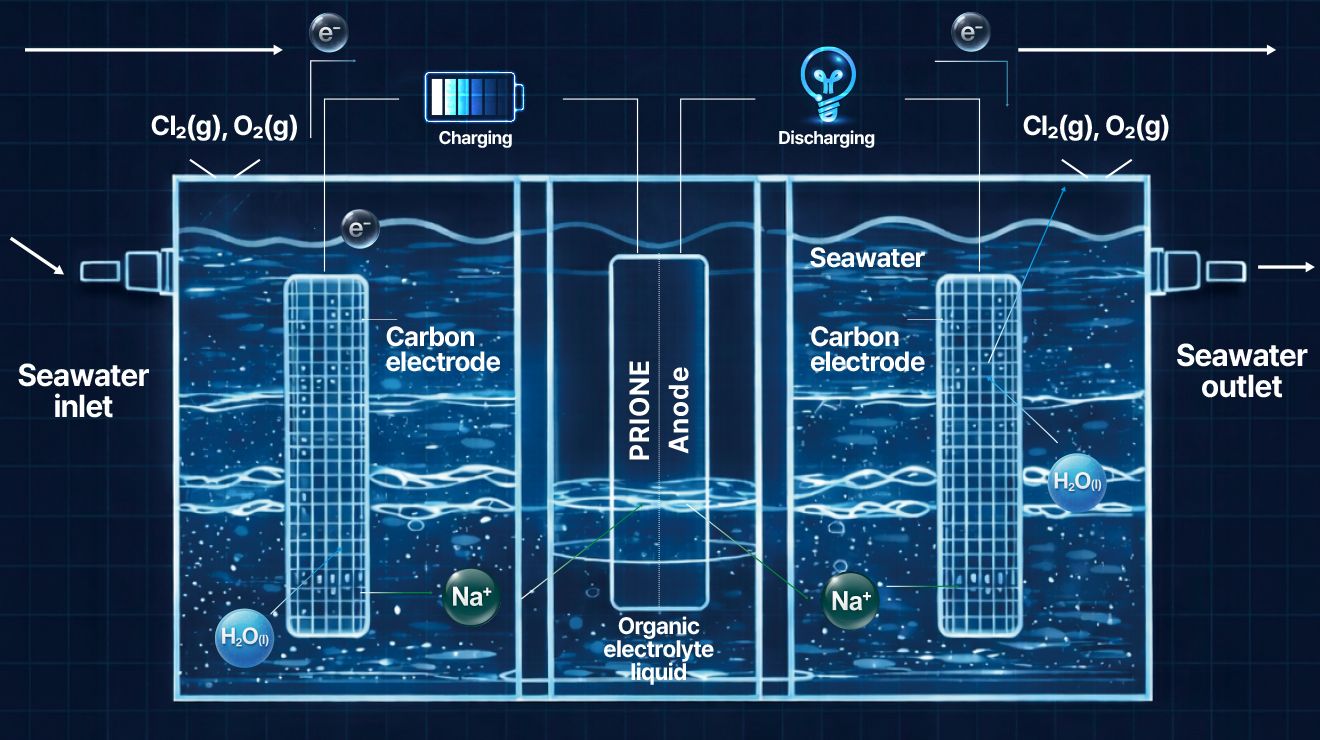
- Charging/Discharging
- Key Advantages
- Pouch Cell
CHARGING / DISCHARGING
A device that stores electrical energy using the sodium ions (Na+) and
water in seawater, with seawater serving as the electrolyte
CHARGING
- Utilizes the sodium present in seawater during charging
- OH- (hydroxide ions) in the seawater generate O2 and H2O,
separating electrons (e-) in the process (OER) - The sodium ions produced move to the anode through the electrolyte
- Electrons (e-) travel through the installed wiring
DISCHARGING
- Oxidation occurs at the sodium in the anode,
producing ions (Na+) and electrons (e-) - The sodium ions (Na+) move to the cathode (seawater) through the electrolyte
- The electrons (e-) travel through the circuit to the cathode, forming an electric current
- At the cathode, sodium ions (Na+),
electrons (e-), dissolved oxygen (O2) in the seawater, and
H2O combine to produce sodium hydroxide (NaOH) (ORR)
KEY ADVANTAGES
-
Eco-friendly
Seawater-based, minimizing environmental pollution
-
Low Cost
Replaces rare metals, reducing production costs
-
High Safety
Low risk of fire and explosion
-
Large-scale Storage
Capable of long-duration, large-scale energy storage
Pouch Cell

-

Increased Productivity
Enables rapid product manufacturing by adopting Roll to Roll technology
-

Uniform Thickness
Maintains uniform material thickness through consistent pressure
-

Continuous Processing
Enables continuous processing using rolls, optimized for mass production
-

Enhanced Bonding Strength
Forms strong bonding strength through compression when joining multiple layers of material